The Pain: Why Cross-Functional Blindness Persists
Here's a scenario every enterprise software company has lived through.
A customer—let's call them Meridian Manufacturing, a $400M industrial products company—is 45 days from renewal. Their invoice is 60 days past due. They have four open P1 service cases. Product usage has dropped 35% over the past quarter. And marketing just sent them an upsell campaign for a premium analytics add-on.
Nobody coordinated this. Nobody even knew the full picture.
The finance team saw the invoice. The service team saw the tickets. The sales team saw the renewal date on a spreadsheet. Marketing saw an ICP match and pulled the trigger. Four teams, four systems, four fragments of a story that—taken together—screams churn risk.
This is the problem the Account Health Orchestration Agent is designed to solve. Not with another dashboard. Not with another data warehouse project. With an AI agent that synthesizes signals across finance, service, sales, and product in real time—and then acts.
Account health isn't a finance metric. It isn't a service metric. It isn't a sales metric. It's a business metric that requires synthesizing authoritative data from systems that were never designed to talk to each other in this way.
The consequences are predictable and expensive. Marketing sends tone-deaf campaigns to distressed accounts. Service teams escalate issues without knowing the commercial context. Sales reps walk into QBRs without knowing their customer filed a severity-one ticket that morning. And by the time someone pieces it all together, the damage is done—the customer has already started a competitive evaluation.
Traditional approaches—building custom integrations, standing up yet another data warehouse, creating cross-functional Slack channels—either take too long, cost too much, or introduce latency that defeats the purpose. By the time your nightly batch job surfaces a risk signal, the upsell email is already in the customer's inbox.
What's needed is a fundamentally different architecture. One where data retains its business context, where signals are synthesized in real time, and where the response isn't a report—it's an action.
The Solution: An Account Health Agent Built on SAP Business Data Cloud
📋 Prerequisites: What Customers Need
This architecture requires SAP's cloud application stack—the data products and zero-copy sharing capabilities in BDC are designed for cloud-native deployments:
- SAP Cloud ERP (Private or Public Edition) — for finance data products
- SAP Sales Cloud and SAP Service Cloud V2 — for CX data products
- SAP Business Data Cloud — includes Datasphere, Knowledge Graph, and curated data products
- SAP Business Technology Platform — for Joule Studio agent development
On-premise S/4HANA customers would need to migrate to RISE with SAP or SAP Cloud ERP Private Edition to access these capabilities.
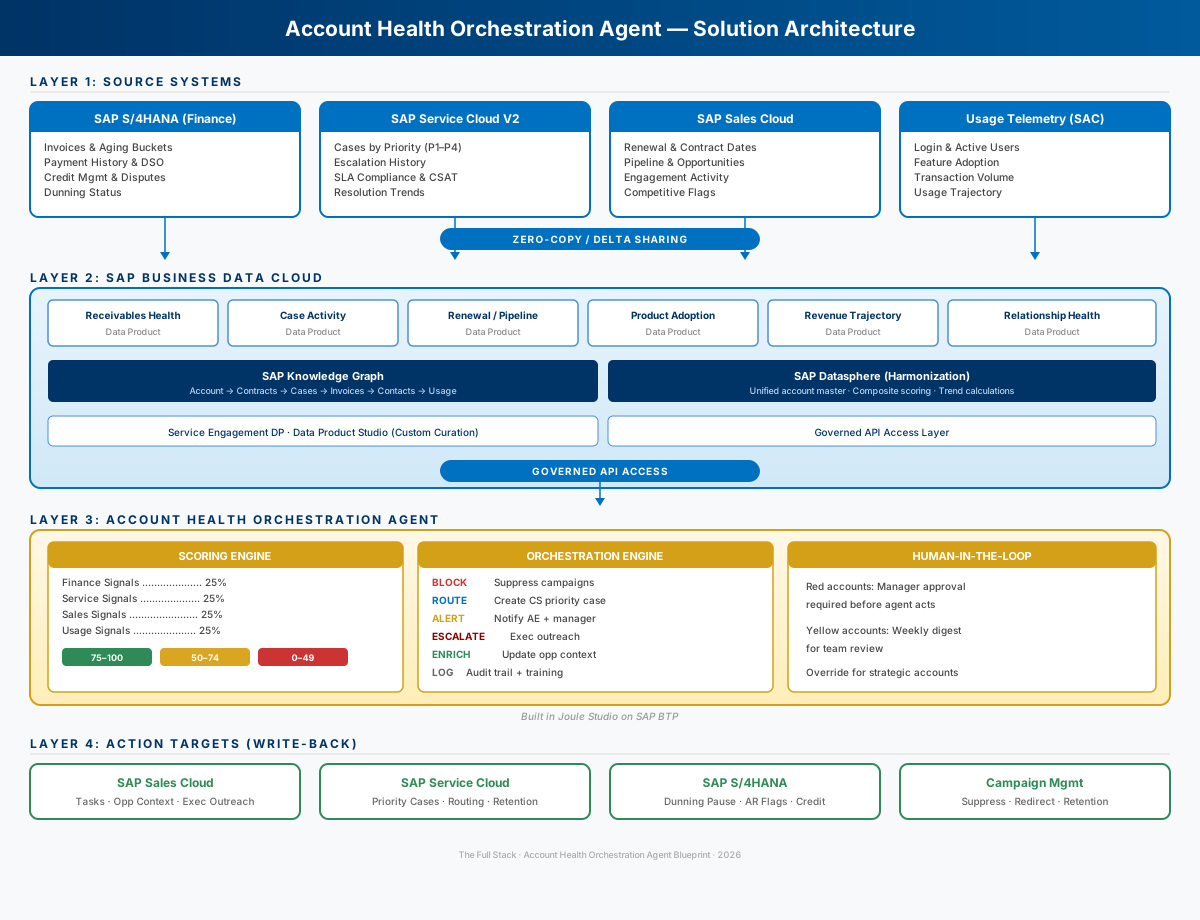
SAP Business Data Cloud (BDC) changes the game because it introduces the concept of data products—curated, semantically enriched, governed data packages that retain their original business context from source applications.
Unlike traditional ETL-and-warehouse approaches, data products in BDC don't strip the meaning out of the data to make it "portable." They carry their business semantics with them.
This is the data fabric architecture that makes an Account Health Orchestration Agent possible. The agent doesn't need to understand the internal data model of SAP S/4HANA or reverse-engineer what a Service Cloud case status means. It consumes data products that already encode that context.
The agent itself would be built using Joule Studio on SAP BTP—SAP's platform for creating custom AI agents that can reason across business processes and take action through the SAP Business Suite. Joule Studio's agent builder, which became generally available in late 2025, provides the low-code/pro-code environment for designing agents that leverage SAP Knowledge Graph for semantic reasoning and can orchestrate multi-step workflows across applications.
The Data Products: What the Agent Needs to See
For the Account Health Orchestration Agent to function, it needs to consume data products from four domains. Think of these as the agent's sensory inputs—the structured, governed data feeds that give it a composite view of every account.
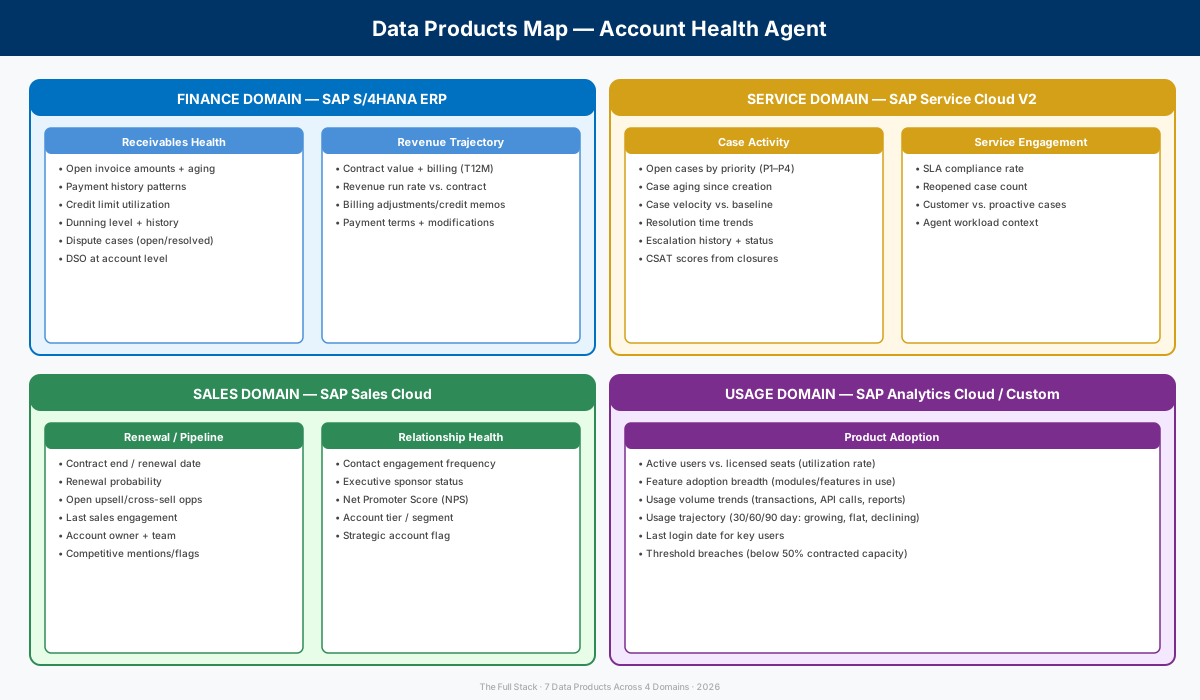
Finance Domain (Source: SAP S/4HANA ERP)
The finance data products provide the commercial foundation. From S/4HANA's Financial Accounting module—specifically Accounts Receivable and Credit Management:
Receivables Health Data Product
- Open invoice amounts and aging buckets (current, 30-day, 60-day, 90-day+)
- Payment history patterns (average days to pay, trend direction)
- Credit limit utilization and any credit holds
- Dunning level and dunning history
- Dispute cases (open, resolved, aging)
- Days Sales Outstanding (DSO) at the account level
Revenue Trajectory Data Product
- Contract value and billing history (trailing 12 months)
- Revenue run rate vs. contracted amounts
- Billing adjustments, credit memos, or write-offs
- Payment terms and any recent modifications
Service Domain (Source: SAP Service Cloud V2)
Service data is the canary in the coal mine for account health. An uptick in case volume, especially at high severity, is one of the strongest leading indicators of churn.
Case Activity Data Product
- Open case count by priority (P1/P2/P3/P4)
- Case aging (time since creation for open cases)
- Case velocity (new cases opened in last 30/60/90 days vs. historical baseline)
- Resolution time trends (getting better or worse?)
- Escalation history and current escalation status
- Customer satisfaction scores (CSAT) from case closures
Service Engagement Data Product
- SLA compliance rate
- Number of reopened cases (indicator of resolution quality)
- Customer-initiated vs. proactive service interactions
- Assigned service agents and their workload context
Sales Domain (Source: SAP Sales Cloud)
The sales data provides the commercial relationship context that determines how much is at stake and how soon.
Renewal and Pipeline Data Product
- Current contract end date and renewal date
- Renewal probability (if scored)
- Open opportunities (upsell/cross-sell in flight)
- Last meaningful sales engagement (meeting, QBR, executive touch)
- Account owner and account team assignments
- Competitive mentions or risk flags in opportunity notes
Relationship Health Data Product
- Key contact engagement frequency
- Executive sponsor status and last interaction
- Net Promoter Score (NPS) if captured
- Account tier/segment classification
- Strategic account flag
Product / Usage Domain (Source: SAP Analytics Cloud via BDC)
Usage data is the behavioral signal that reveals whether the customer is getting value from what they've bought.
Product Adoption Data Product
- Active users vs. licensed seats (license utilization rate)
- Feature adoption breadth (how many modules/features in active use)
- Usage volume trends (transactions, API calls, reports run)
- Usage trajectory (30/60/90 day trend: growing, flat, declining)
- Last login date for key users
- Usage threshold breaches (e.g., dropped below 50% of contracted capacity)
The Agent Architecture: Scoring, Orchestration, and Action
The Account Health Orchestration Agent has three core engines, all built in Joule Studio on SAP BTP.
Scoring Engine
A composite health score (0–100) is calculated from four signal domains:
| Signal Domain | Key Indicators | Weight |
|---|---|---|
| Finance Signals | AR aging, payment trends, DSO, credit utilization | 25% |
| Service Signals | Case volume and severity, resolution trends, CSAT | 25% |
| Sales Signals | Renewal proximity, engagement recency, competitive flags | 25% |
| Usage Signals | Adoption trajectory, utilization rate, feature breadth | 25% |
| GREEN (75–100) | YELLOW (50–74) | RED (0–49) |
|---|---|---|
| Healthy — Growth mode | Watch — Weekly digest | At-risk — Immediate action |
Orchestration Engine
When the score drops below threshold—or specific trigger combinations fire—the agent executes a coordinated response:
Human-in-the-Loop
Red account actions require manager approval before execution. Yellow accounts generate weekly review digests. Strategic account exceptions can override automated actions. This isn't about removing human judgment—it's about making human judgment faster and better informed.
Walking Through the Scenario
Let's go back to Meridian Manufacturing and trace what happens with the agent in place.
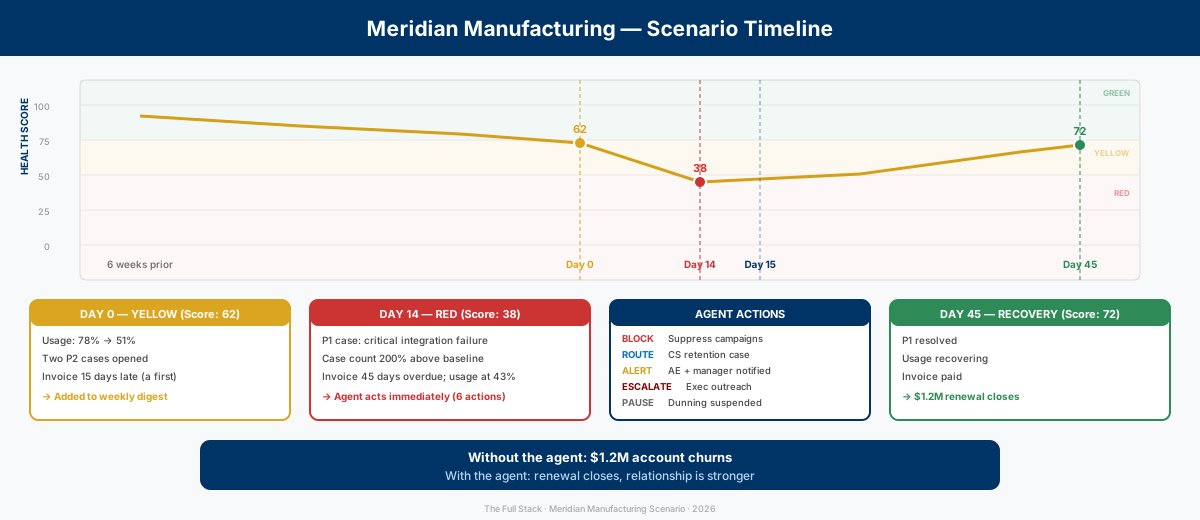
Day 0: Early Warning
Meridian's composite health score has been drifting downward for six weeks. Usage dropped from 78% to 51% of licensed capacity. Two P2 cases were opened last month. Payment on their last invoice was 15 days late—a first. The agent scores them at 62 (Yellow) and adds them to the weekly review digest.
Day 14: Score Drops to Red
A third service case comes in—this time a P1 involving a critical integration failure. The case count now exceeds Meridian's 90-day baseline by 200%. The invoice hits 45 days overdue. Usage drops to 43%. The agent recalculates: score drops to 38 (Red).
The Agent Acts — Within Minutes, Not Days
- Suppresses the upcoming product launch campaign that marketing had Meridian queued for.
- Creates a priority retention case in Service Cloud, pre-populated with the full context: finance status, case history, usage decline, renewal timeline.
- Alerts the account executive and their manager via Sales Cloud task with a health summary and recommended next steps.
- Queues an executive outreach request, flagging this for VP-level engagement given the account's $1.2M annual contract value.
- Pauses automated dunning on the outstanding invoice, since aggressive collections on a distressed account would accelerate churn.
- Logs all actions with full reasoning chain for audit and model training.
Day 15: Human Engagement, Fully Informed
The account executive—now armed with the full picture—reaches out to Meridian's VP of Operations. The conversation is informed, empathetic, and productive. They identify the integration failure as the root cause of the usage decline and the payment delay. A dedicated support engineer is assigned. The executive sponsor schedules a quarterly check-in.
Day 45: Recovery
The P1 is resolved. Usage is recovering. The invoice is paid.
The renewal conversation starts from a position of partnership, not damage control.
Without the agent, this account churns. With it, the $1.2M renewal closes—and the relationship is actually stronger.
The ROI Model: Making the Business Case
The ROI for an Account Health Orchestration Agent comes from three primary value drivers.
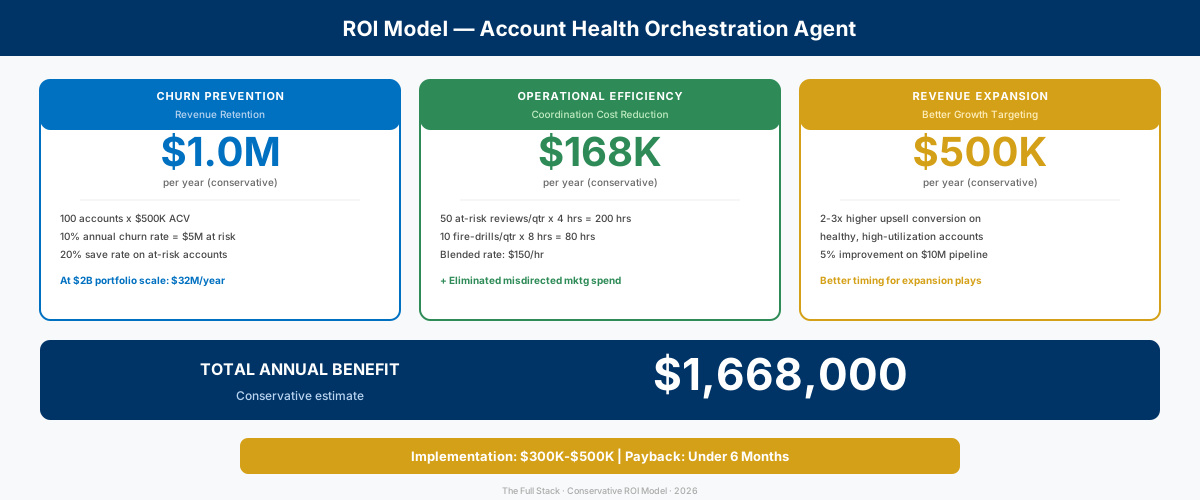
1. Churn Prevention (Revenue Retention)
This is the headline number. For a B2B enterprise with 100 accounts at $500K average contract value and a 10% annual churn rate, that's $5M walking out the door every year. Even a conservative 20% save rate on at-risk accounts translates to $1M in retained revenue annually.
For larger portfolios, the math gets dramatic. A $2B enterprise portfolio with 8% churn and a 20% save rate = $32M in retained revenue per year.
2. Operational Efficiency
The hidden cost of poor account health visibility is the time teams spend manually assembling the picture and coordinating responses. Account reviews run 2–4 hours per account. Churn fire-drills consume 5–10 hours across multiple teams. At blended rates of $150/hour, that's roughly $168K per year in coordination costs avoided.
3. Revenue Expansion
By clearly identifying which accounts are healthy, the agent sharpens upsell and cross-sell targeting. Campaigns directed at genuinely healthy, high-utilization accounts convert at 2–3x higher rates. Even a 5% improvement across a $10M expansion pipeline = $500K in incremental revenue.
| Value Driver | Conservative Estimate |
|---|---|
| Churn prevention (retained revenue) | $1,000,000 |
| Operational efficiency | $168,000 |
| Revenue expansion (better targeting) | $500,000 |
| Total Annual Benefit | $1,668,000 |
Against an implementation investment of $300K–$500K (inclusive of BDC subscription uplift, Joule Studio agent development, integration work, and change management), the payback period is well under 6 months.
Note: This ROI model assumes the customer is already on SAP Cloud ERP (Private or Public Edition) and SAP Cloud CX applications. Customers migrating from on-premise would need to factor in RISE with SAP transformation costs.
Implementation Roadmap
| Phase | Activities | Key Deliverables |
|---|---|---|
| Phase 1 Data Foundation (Weeks 1–8) |
Deploy BDC; connect S/4HANA, Sales Cloud, Service Cloud; curate initial data products | Unified account master in Datasphere; health scoring model defined with stakeholders |
| Phase 2 Agent Development (Weeks 6–14) |
Build agent in Joule Studio; implement scoring engine; configure orchestration rules | Working agent with scoring, orchestration, and human-in-the-loop approval flows |
| Phase 3 Integration & Test (Weeks 12–20) |
Wire write-back actions; run shadow mode 4–6 weeks; validate against historical churn data | Refined thresholds and weights; validated score accuracy; integration testing complete |
| Phase 4 Go-Live & Optimize (Week 20+) |
Enable agent actions; automate Yellow account workflows; establish feedback loops | Live agent with continuous improvement; expanded signal sources over time |
Why Data Fabric Is the Unlock
You could try to build this with point-to-point integrations. You could extract data from each system into a warehouse, write some Python, and stand up a dashboard. Companies have been trying for years. It doesn't work—not at scale, not with freshness, and not with the semantic richness that an agent needs to reason correctly.
The data fabric architecture in SAP Business Data Cloud is what makes this viable. Zero-copy access means the agent reads from authoritative systems of record, not stale copies. Semantic enrichment through Knowledge Graph means the agent understands that an "invoice" in S/4HANA and a "contract" in Sales Cloud relate to the same customer—without custom mapping code. And governed data products mean the agent's inputs are curated, documented, and trustworthy.
This is the pattern that separates agentic AI from chatbot AI. A chatbot can answer questions about an account. An agent can protect an account. But only if it has a data fabric underneath it.
The Account Health Orchestration Agent represents one of the most compelling near-term use cases for agentic AI in B2B enterprise software—not because the technology is exotic, but because the business problem is universal and the SAP data infrastructure to solve it is now available. The companies that build this first won't just reduce churn. They'll fundamentally change how their organizations experience customer relationships.