
With a background in building executive communities like the CPO Think Tank and leading competitive field readiness initiatives, Soo has spent her career translating complex product portfolios into clear, differentiated value stories. Her latest experiment takes that expertise to a new level: BattleCoach—an AI-powered competitive co-pilot and deal simulator for sellers.
But here's what makes Soo's project different from most AI experiments: she's not just building a tool. She's rethinking the entire model of how competitive intelligence gets delivered to the field.
The Mandate—and the Problem
"Focus on conversion. Arm the field with updated messaging and scripts—helping them script their customer meetings and ensuring they know our latest differentiated messaging."
That's the directive from leadership. Clear enough. But when Soo looked at how competitive enablement actually worked in practice, she found a series of uncomfortable truths:
🚨 The Reality Check
- Field says they're not competitively enabled—despite all the content we create
- Content exists—but it's static, not deal-specific
- We only have portfolio-level battlecards (Ariba vs X)—not solution-level guidance
- No buyer-centric competitive positioning—just feature comparisons
- Sellers are recreating messaging in every deal—reinventing the wheel constantly
And perhaps the most damning insight of all:
"Our competitive messaging often fails the logo swap test."
If you can swap your company's logo for a competitor's and the messaging still works, you don't have differentiation—you have generic claims. Soo wanted to fix that.
The Vision: Crawl → Walk → Run
Rather than trying to build the perfect AI system from day one, Soo designed a phased approach that would build capability progressively—starting with foundational work and evolving toward true agentic AI.
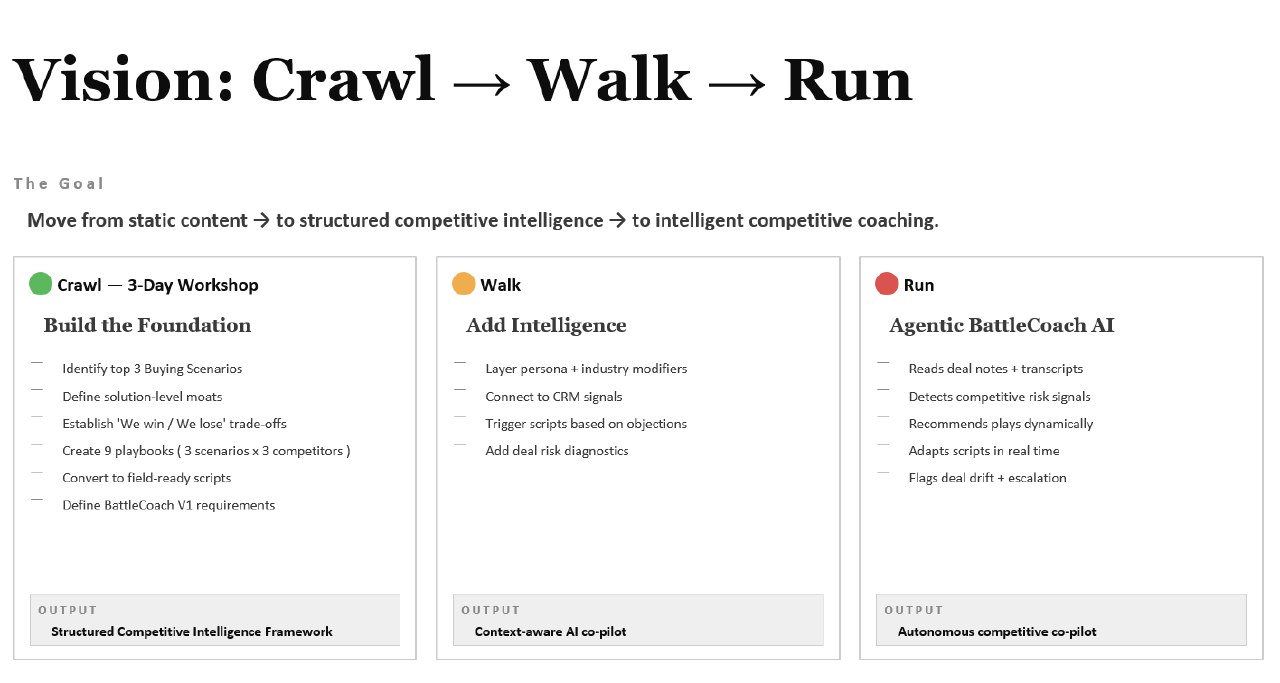
The goal isn't just to move from static content to intelligent systems. It's to move from "hoping differentiation sticks" to "institutionalizing PMM intelligence into a scalable system."
Inside BattleCoach
Soo is proposing a 3-day competitive workshop—what she calls "bringing PMM and Field together to build the foundation for systematic change." The math is elegant: 3 buying scenarios × 3 competitors = 9 solution-level playbooks.
But here's the key insight: "AI still needs our brain inputs." The workshop isn't about letting AI generate generic content—it's about encoding the collective competitive intelligence of experienced PMMs and sellers into a system that can scale. That's the secret weapon.
The goal is to move from static content → to structured competitive intelligence → to intelligent competitive coaching. The prototype treats AI as a structured reasoning engine, not just a content generator.
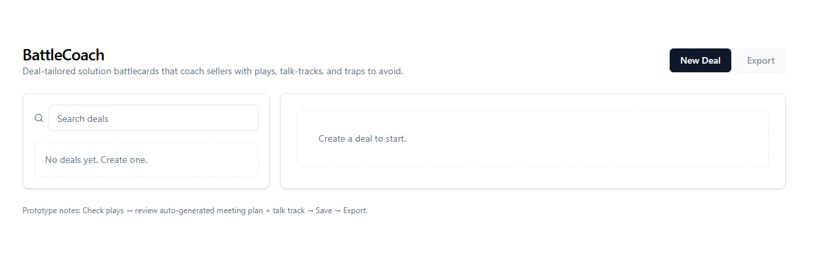
When a seller enters a deal, BattleCoach doesn't serve up a static PDF. It generates contextual guidance based on the deal stage, competitor, and vertical—complete with specific plays, talk tracks, and traps to avoid.
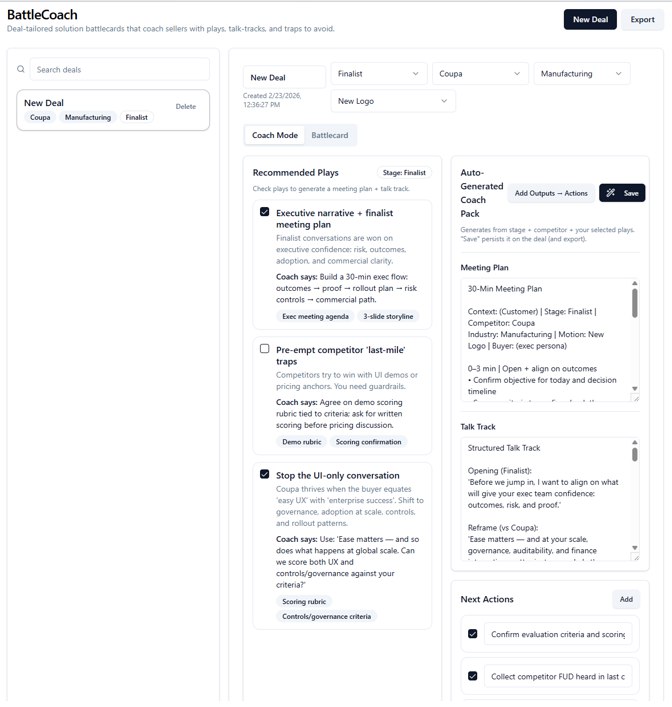
Look at what Coach Mode generates for a deal against Coupa in Manufacturing:
- "Executive narrative + finalist meeting plan"—Build a 30-min exec flow with proof points, rollout plan, and risk controls
- "Pre-empt competitor 'last-mile' traps"—Counter Coupa's typical demo and pricing tactics
- "Stop the UI-only conversation"—Shift from "easy UX" to governance, adoption at scale, and rollout patterns
This isn't generic battlecard content. It's deal-specific competitive coaching—the kind of guidance that used to require a PMM to personally review every deal.
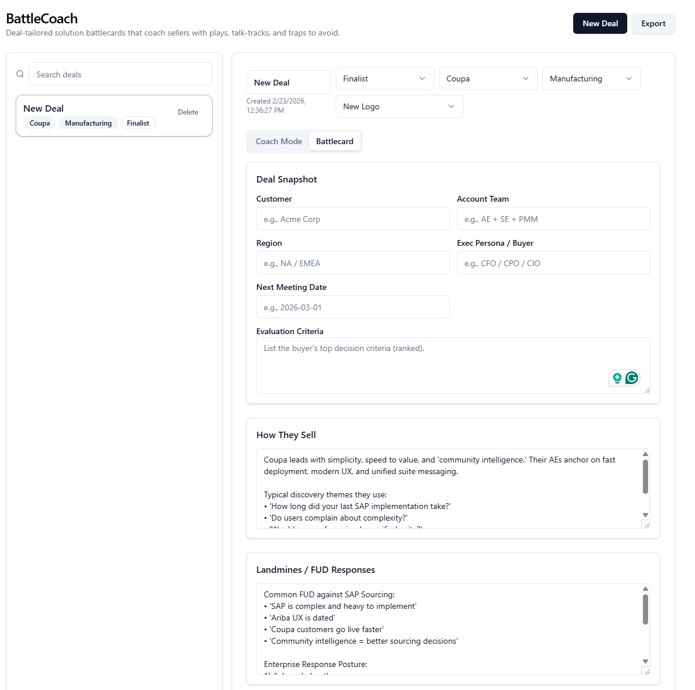
Switch to the Battlecard tab and you get the competitive intelligence layer: how the competitor sells, typical discovery questions they use, and pre-built responses to common FUD like "SAP is complex" or "Ariba UX is dated."
Why This Matters Beyond SAP
What Soo is building represents a fundamental shift in how competitive intelligence could work. Instead of sending decks to the field and hoping differentiation sticks, BattleCoach delivers:
- Rehearsal before executive conversations—sellers can practice against simulated scenarios
- Repeatable competitive thinking—not dependent on individual PMM availability
- Faster confidence in deal strategy—guidance in minutes, not days
- Institutionalized PMM intelligence—tribal knowledge becomes scalable systems
The Bigger Lesson
What makes Soo's approach remarkable isn't just the technology—it's the reframe. She recognized that AI for PMM isn't about writing faster. It's about building new capabilities:
"AI is not just a writing assistant. It can be a simulation engine, a structured thinking partner, a system that captures institutional differentiation, and a way to prototype new enablement models before formal investment."
What started as a workshop proposal is now shaping how competitive excellence could become an embedded capability—not just an asset repository.
Building Something Similar?
We want to hear from PMM teams using AI to transform their work. Share your story.
Get in Touch →