Douwe Bergsma, CMO of Georgia-Pacific, walked into our meeting with a question that stopped me cold.
"You may be wondering why a company that sells toilet paper, paper towels, and napkins needs a data management platform." He paused, just long enough to let the absurdity land. "We thought perhaps you could tell us."
I've been in a lot of conference rooms over the past twenty years—pitching DMPs, then CDPs, now agentic AI—and Douwe's question captures something I've never quite been able to shake. The most important transformations in business are, on paper, spectacularly boring. Data management platforms. Identity resolution. Journey orchestration. API response latency optimization. Try explaining any of that at a dinner party. I dare you.
And yet I've watched billion-dollar decisions stall because the people who needed to make them couldn't connect the technical capability to the business outcome. The technology matters. The architecture matters. But none of it moves without a story that makes someone feel why it matters.
That's what this essay is about: ten stories from three books and nearly a decade of trying to make the technical human. Some of them worked. Some of them taught me something I didn't expect. All of them stuck.
The Oldest Technology
Before I get to the stories, a confession: I think about Joseph Campbell more than any marketing executive probably should.
Campbell spent his life studying the monomyth—the Hero's Journey—and what he found was that the same narrative structure appears independently across every culture on earth. A hero is called to adventure, crosses into the unknown, faces trials, meets mentors, confronts death, returns transformed. You've seen it a thousand times. Star Wars. The Matrix. Every Pixar movie. Every Hallmark Christmas film—though in those the "death" is usually just moving back to the small town where your high school sweetheart still runs the tree farm.
My co-author Martin Kihn wrote about narrative weaponization in House of Lies, exploring how consultants use story to sell ideas that spreadsheets alone could never move. The insight wasn't cynical—it was honest. Humans don't process data the way we process stories. Data informs. Stories transform.
We're wired for it. Two million years of sitting around fires, passing survival knowledge through narrative, will do that to a species.
Steve Jobs understood this. He didn't sell MP3 players. He sold "a thousand songs in your pocket." Salesforce didn't sell CRM software. They sold "no software"—a vision of a world without the pain of enterprise IT. When I started writing Data Driven in 2017, I had a choice: write a technical manual about data platforms, or tell stories about the people using data to transform their businesses. I could explain identity graphs, or I could tell you about Mike Cunningham's dream of putting a $5 chip in every Keurig coffee maker.
The technical manual would have been accurate. The stories were memorable.
The Stories
1. The $5 Chip
In 2015, Mike Cunningham—Chief Digital Officer at Keurig Green Mountain—had a vision that I still think about. Put a data collection chip in every coffee maker. Optical scanner to identify K-Cups. Bluetooth beacon to detect mobile devices. LCD screen for targeted messages. "Can you tell me what it's worth?" he asked.
The math worked. You could move from "Walmart ordered 50,000 K-Cups" to knowing that Dad drinks dark roast Sumatra at 6am, Mom prefers French Hazelnut at 7:30, and the twelve-year-old sneaks Donut Shop K-Cups on weekends when nobody's watching.
Keurig decided not to build it.
But here's the thing: if Mike asked me today, I'd give him completely different advice. "You don't need the chip. The customer's agent already knows all of that." The question isn't "how do we discover the customer?" anymore. It's "how do we become the brand the customer's agent chooses by default?"
2. Casey's Pizza
Casey's General Stores partnered with an agency called Boom Boom Jones—yes, that's real—on something deceptively simple: personalized emails to lapsed pizza customers. The innovation? Put a picture of the customer's usual order in the email. Not a stock photo. Their pizza. The pepperoni and mushroom they ordered every Friday for six months.
300% lift in conversion. No AI. No billion-dollar infrastructure. Just connecting the email system to the point-of-sale data.
I used to tell this story as a pure win. But writing The Agentic Customer made me realize something: that personalized pizza picture was optimized for human psychology. The nostalgic pull. The visual appeal. The implicit message: we remember you. An AI agent doesn't feel nostalgia. It needs structured data—availability, price, delivery time. The 300% lift was real, but it was real for humans. The future requires winning over both.
3. The Toilet Paper Question
Back to Douwe Bergsma. Georgia-Pacific didn't have CRM records for the millions of people buying Brawny at Walmart. They had no direct relationship with their customers at all. But they had millions in media spending generating behavioral signals—people who clicked on ads, visited content, engaged with campaigns. The challenge in 2017 was figuring out how to capture data about customers you never directly touch.
The challenge in 2026 is different: how do you make your products machine-readable when the customer's agent is doing the shopping? The first was about knowing the customer. The second is about being known by the customer's agent. Same company, same products, completely different question.
4. Campbell's Weather
Campbell's Soup Company has been using weather data to direct marketing budgets since the 1950s. I love this one because it's so obvious in hindsight—people buy more soup when it's cold—and yet they've been refining the approach for seventy years. Radio spots in the '50s, television in the '60s, digital targeting in the 2000s. Cold snap coming to Chicago? Surge the spend. Warm front in Phoenix? Pull back. They turned it into a science.
Seventy years of institutional knowledge. But the agent doesn't care about your institutional knowledge. It cares about structured data, real-time availability, and competitive pricing—right now. Campbell's knows more about weather-driven demand than anyone on earth, and that might not matter at all.
5. Pandora's Playlist
Pandora discovered that your playlist reveals almost everything about you. Lots of alternative music, 2000s-era hip hop, and occasional dips into "Sleepy Time" playlists? You're probably mid-30s with a six-year-old in the house. No surveys needed. No registration forms. Just behavior revealing demographics.
This is Principle #2 from Data Driven in action: you have more data than you think. The signals are there. The question is whether you're capturing and connecting them. It's also one of the only principles that translates cleanly into the agentic era—because an agent can do the same inference, just faster and at scale.
6. The Porsche on the Tarmac
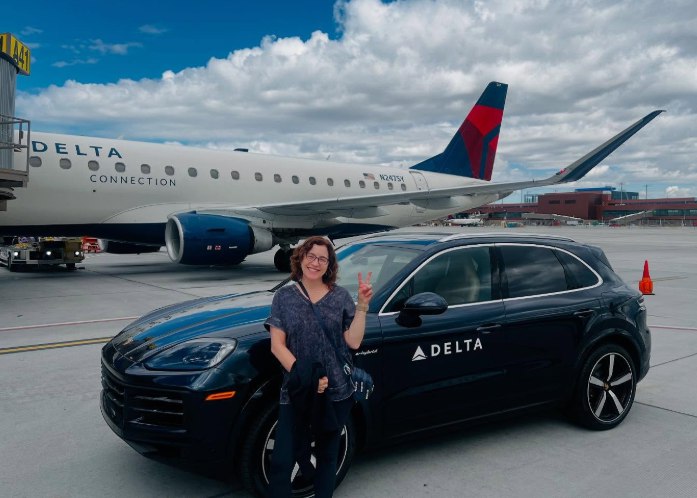
My family was about to miss a connection in Atlanta—entire vacation to St. Thomas at risk—so I did what any reasonable person would do: I tweeted @Delta.
They met us at the gate, took us down to the tarmac, and whisked us between concourses in a Porsche Macan.
What was that worth? I may never book another airline again.
This is what unified customer data actually feels like. Not a dashboard. Not a segment. A moment where everything a company knows about you comes together to save your vacation. Data enables. Experience delivers. (I'm allowed one bumper sticker per essay. That's mine.)
Let me skip ahead to the three stories that keep me up at night—the ones that suggest the rules might be changing faster than most companies realize.
7. The Inverted Bullseye
Years ago, Ronald den Elzen—CEO of Heineken USA—drew a bullseye on the whiteboard. Outer ring: 320 million Americans. Next: 140 million legal drinking age. Then 90 million who drink alcohol. Then 60 million who drink beer. Center: 18-20 million Heineken lovers.
"Can you help me find these people?"
That question defined an era. Data-driven audience targeting made that filtering possible at scale.
Now imagine the bullseye inverted. A customer's agent broadcasting out from the center: "My principal is a 38-year-old male, drinks premium imported lager, prefers bottles, $15/six-pack budget, values sustainability." The agent isn't waiting to be found. It's announcing preferences and inviting brands to compete. Ronald's question becomes: "Can you help me be found?"
8. Apex Home Goods
I call them Apex Home Goods because I promised I wouldn't use their real name. They built everything my books prescribed: unified customer data, journey orchestration, ML-powered segmentation, a Center of Excellence. Eight figures invested. Level 4 maturity. The CMO presented at conferences. They were the case study.
Then in 2025, the metrics plateaued. Email open rates stopped growing. But customers were still buying—more precisely than before. Less browsing. Fewer page views. Shorter sessions.
It took us three months to figure out what was happening. The customers had delegated. Their AI agents were doing the research, comparison, and negotiation. By the time humans clicked "buy," the decision was already made. Apex's beautiful, emotionally resonant customer experience? The agent couldn't see it. Couldn't process it. Didn't care.
Doing everything right for the last paradigm doesn't protect you from the next one. That lesson cost them eight figures to learn.
9. Joe Then and Now
In 2018, Joe's car-buying journey touched dozens of systems. Cable ad, Facebook, tablet browse, desktop research, credit app, dealership beacon, second dealer, email signup, video retargeting. Hundreds of signals. Nobody saw the whole picture. For two years after buying his car, Joe got served ads for the car he already owned.
In 2026, Joe's agent absorbed requirements through conversation. Queried twelve manufacturers in seconds. Evaluated specs, safety ratings, ownership costs. Negotiated with multiple dealers simultaneously. Joe walked into one dealership, already approved, price set. Signed and drove home.
The 2018 journey was chaos. The 2026 journey was choreographed by an AI better at car shopping than Joe ever was. The question isn't "how do we track the journey?" anymore. There's no journey to track.
10. Father Schmitt's Mainframe
In 1961, Father Theodore Schmitt—a Catholic priest at St. Mary's in Colorado—did something remarkable: he computerized his donor records on an IBM 650 mainframe. While Madison Avenue was still buying television time by the gross, Father Schmitt was personalizing donation appeals based on giving history, parish involvement, and life events.
His mainframe processed dozens of records per hour. An AI agent evaluates dozens of brands per second. Six orders of magnitude faster. But the logic didn't change at all: personalize the outreach, match the message to the recipient, remember what worked.
The technology changes; the principles compound. That's the thread that runs through every story in this series—and the reason I believe storytelling still matters, even when the audience isn't human.
I mentioned Father Schmitt at a conference last year—the Catholic priest who computerized donor records on an IBM 650 mainframe in 1961. That story came from my co-author Martin Kihn, who dug it up while researching at Salesforce. Someone in the audience asked why I keep reaching back to ancient history.
Fair question. Here's my answer: Father Schmitt's mainframe processed dozens of records per hour. An AI agent evaluates dozens of brands per second. Six orders of magnitude faster. But the logic didn't change at all. Personalize the outreach. Match the message to the recipient. Remember what worked. The technology changes; the principles compound.
The same is true for storytelling. The agentic revolution will transform commerce—I believe it's the most significant shift in our lifetimes—but agents don't set preferences. Humans do. The customer who tells their agent "I only buy from sustainable brands" got that value somewhere. Brand story influences how humans configure their agents. The story happens before the agent gets involved.
And the transformation itself requires stories. The CMO who needs to invest eight figures in agent-ready infrastructure isn't going to be moved by a technical spec sheet. They need to see what's possible. They need to feel the urgency. They need a story about Apex Home Goods doing everything right and still getting blindsided—and then they need a story about what to do instead.
The companies that win won't just have the best APIs. They'll have the clearest stories about why their transformation matters—stories that move executives to invest, employees to execute, and humans to tell their agents which brands to trust.
Data advantage is temporary. Someone will always have more data, fresher data, better data. But story advantage compounds. Father Schmitt understood that in 1961. Douwe Bergsma understood it when he walked into that conference room with his impossible question about toilet paper. The agents don't care about stories—but the people programming the agents still do.
That's why stories still win.